
UI-MOPD: Multi-Platform On-Policy Distillation for Unified GUI Agents
1Tsinghua Shenzhen International Graduate School, Tsinghua University, 2Xiaomi
3Harbin Institute of Technology, Shenzhen, 4Zhejiang University, 5Peng Cheng Laboratory




 HuggingFace
1Tsinghua Shenzhen International Graduate School, Tsinghua University, 2Xiaomi
3Harbin Institute of Technology, Shenzhen, 4Zhejiang University, 5Peng Cheng Laboratory
Recent advances in multimodal foundation models and agent systems have driven GUI agents from single-platform task execution toward cross-platform interaction. However, unified multi-platform GUI learning remains challenging: high-quality cross-platform trajectories remain scarce, while platforms share transferable capabilities but differ in action semantics and interaction conventions. Naively mixing supervision or merging specialized models can blur native behaviors and produce imbalanced performance. To address these challenges, we construct Uni-GUI, a high-quality dataset containing nearly 10K executable cross-platform interaction trajectories collected through a unified desktop-mobile harness. Building on Uni-GUI, we propose UI-MOPD, the first framework to introduce multi-teacher on-policy distillation (MOPD) into unified multi-platform GUI agent training. UI-MOPD trains a shared student on its own rollouts and dynamically routes each rollout to the corresponding platform-specialized teacher. At student-visited states, teacher guidance serves as a platform-conditioned behavioral anchor, enabling the integration of complementary desktop and mobile expertise without averaging their distinct interaction conventions. On OSWorld and MobileWorld, UI-MOPD achieves task success rates of 38.2% and 12.0%, respectively, outperforming parameter-matched integration strategies while preserving general GUI grounding. These results demonstrate that multi-teacher on-policy distillation provides an effective approach to building unified cross-platform GUI agents.
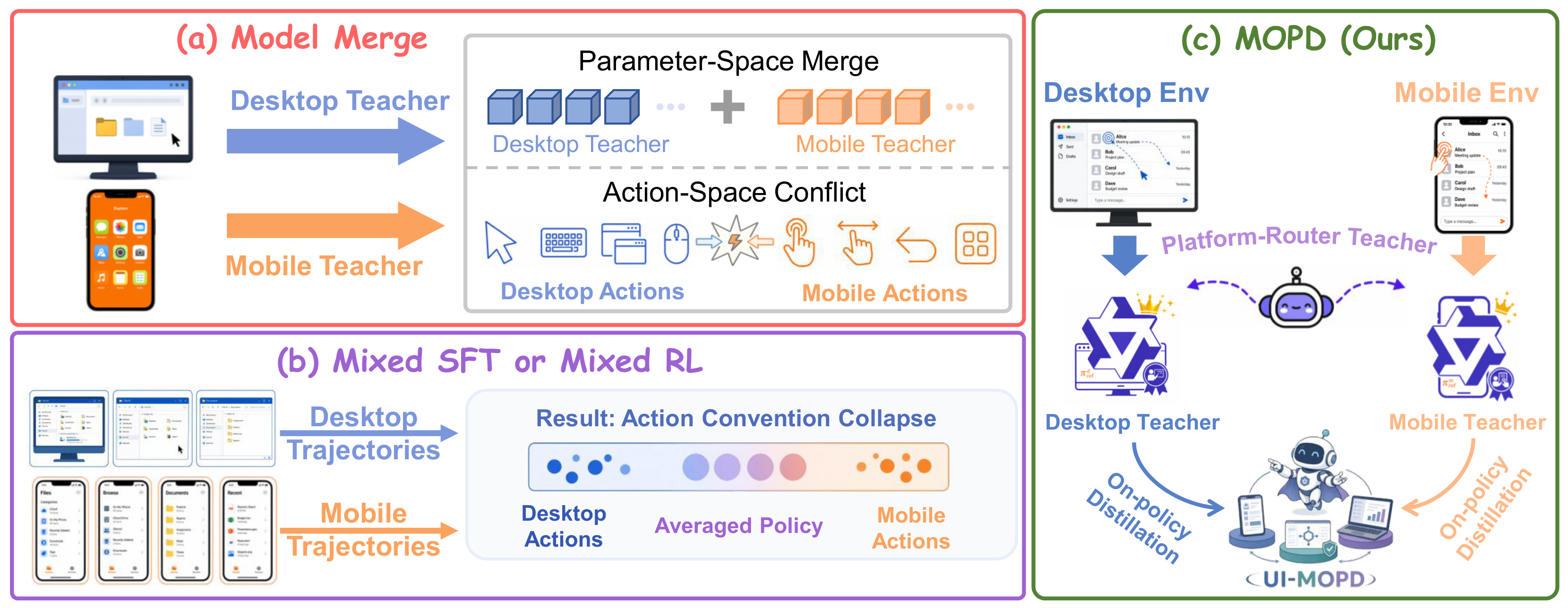
Figure 1. Motivation of UI-MOPD. Naively combining desktop and mobile signals, as in model merging, mixed SFT, or mixed RL, can mix platform-specific behavioral conventions and produce an averaged policy. UI-MOPD uses platform-conditioned routing and multi-teacher on-policy distillation to integrate platform-specific expertise into a shared GUI agent.
Fine-tune Qwen3-VL-32B-Thinking on the Uni-GUI dataset to obtain platform-specific expert teachers: a desktop teacher and a mobile teacher.
Train a shared student policy (Qwen3-VL-8B-Thinking) with reinforcement learning and platform-conditioned teacher routing for continual cross-platform learning.
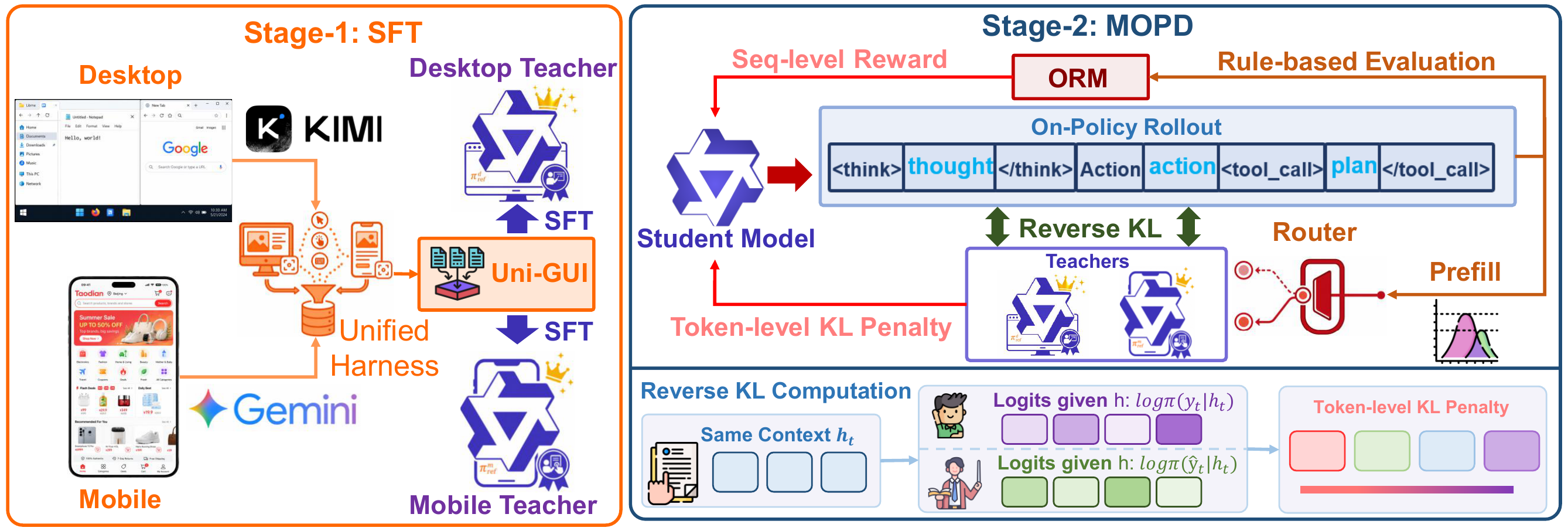
Figure 2. Overview of the UI-MOPD training pipeline. Stage 1 performs supervised fine-tuning to obtain platform-specific teachers. Stage 2 applies multi-teacher on-policy distillation with platform-conditioned routing, adaptive KL masking, and structured outcome reward.
Routes each rollout to the corresponding platform-specific teacher based on the current environment type.
Efficient single-sample KL divergence estimator that avoids full vocabulary computation, reducing memory and compute overhead.
Removes teacher penalty when task reward is already sufficient, preventing over-regularization.
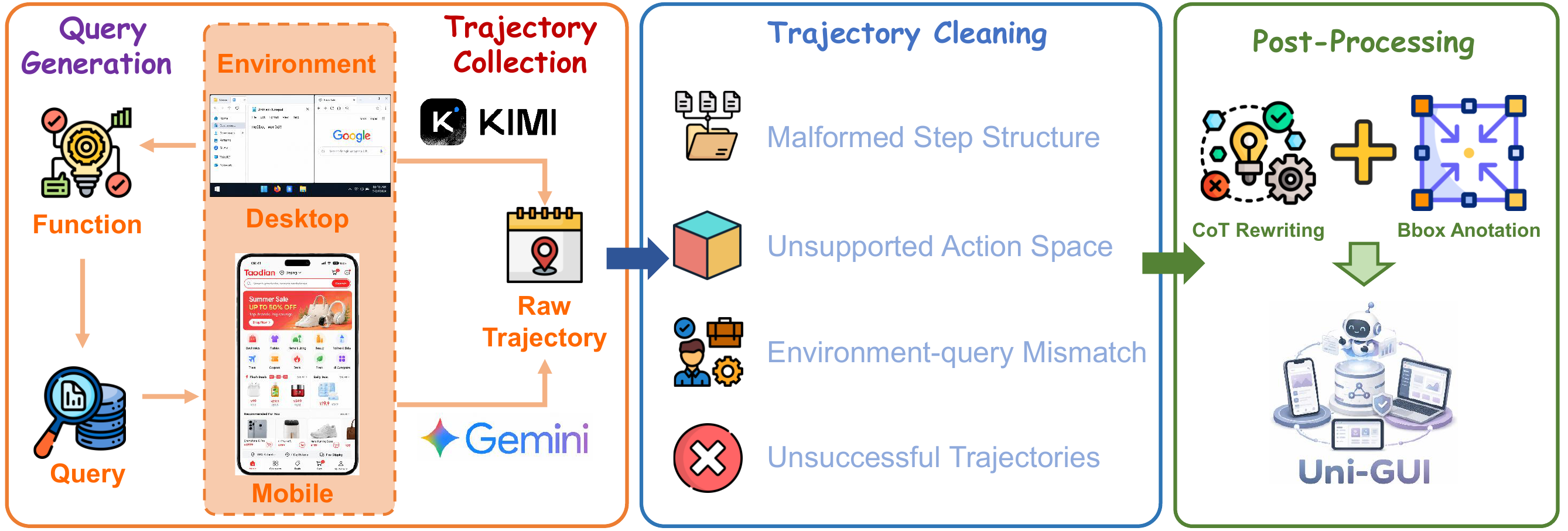
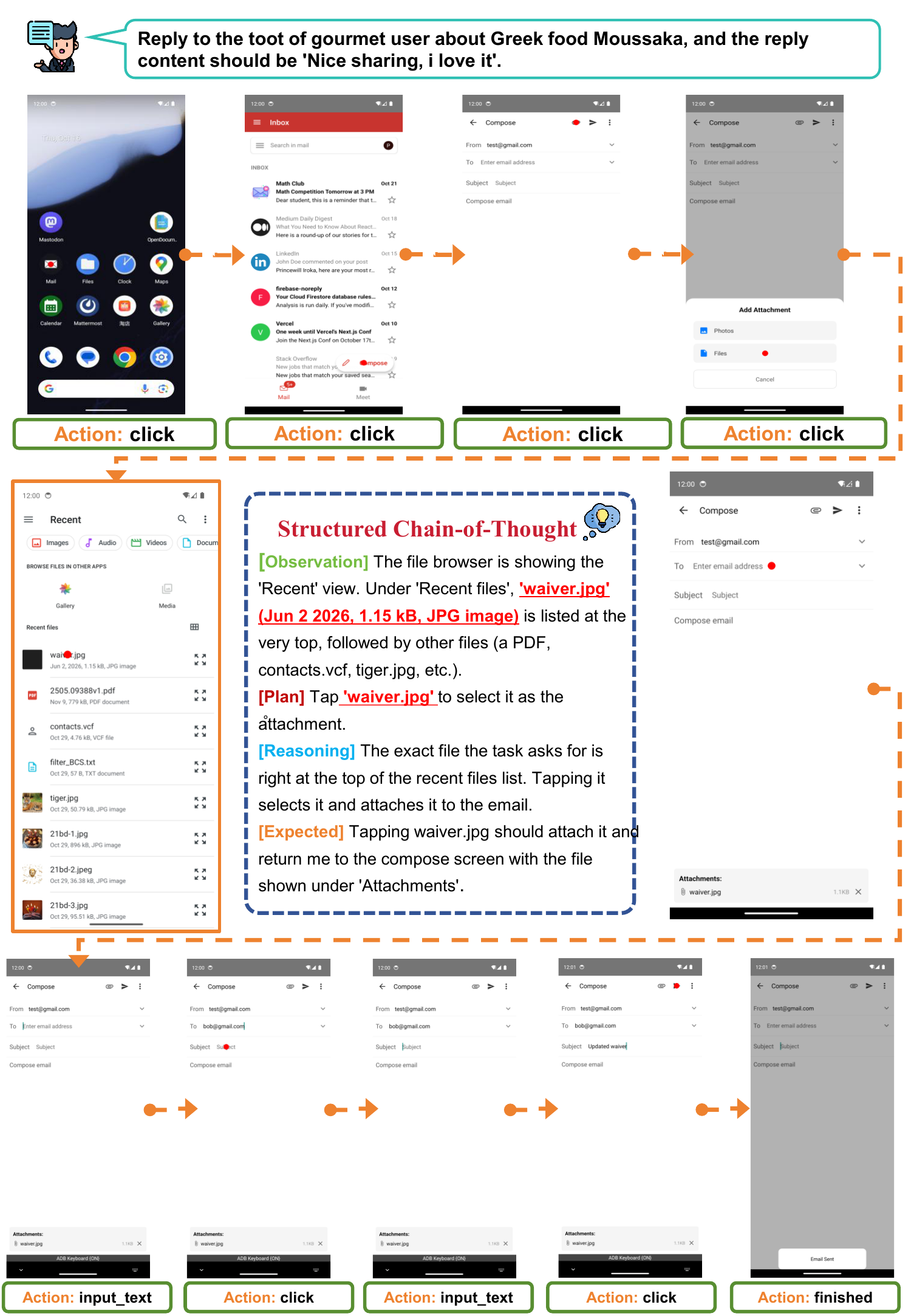
Figure 3. Overview of the Unified Cross-Platform Data Collection Harness used to build the Uni-GUI dataset.
Baselines and integration strategies on OSWorld and MobileWorld (Table 1).
| Method | OSWorld | MobileWorld |
|---|---|---|
| General Models | ||
| SeedVL-1.5 | 34.1% | -- |
| Qwen3-VL-8B-Instruct | 33.9% | 9.4% |
| Qwen3-VL-8B-Thinking | 33.9% | 7.7% |
| Qwen3-VL-32B-Instruct | 32.6% | 9.0% |
| Qwen3-VL-235B-A22B-Instruct | 31.6% | 9.5% |
| Qwen3-VL-235B-A22B-Thinking | 38.1% | -- |
| GUI Models (Single-Platform) | ||
| OpenCUA-7B | 28.2% | -- |
| OpenAI CUA o3 | 31.3% | -- |
| OpenCUA-32B | 34.8% | -- |
| GUI Models (Multi-Platform) | ||
| UI-TARS-72B-DPO | 27.1% | -- |
| UI-TARS-1.5-7B | 27.4% | -- |
| GELab-Zero-4B | 31.9% | 10.9% |
| GUI-Owl-7B | 34.9% | 4.5% |
| GUI-Owl-32B | -- | 5.5% |
| Integration Strategies | ||
| Mixed-SFT | 35.0% | 6.4% |
| Model Merge (Weight Averaging) | 36.5% | 6.8% |
| Model Merge (TIES Merging) | 36.8% | 0% |
| UI-MOPD (Ours) | 38.2% | 12.0% |
UI-MOPD achieves state-of-the-art balanced cross-platform performance, demonstrating effective capability retention on desktop while significantly improving mobile task success rate.
Teacher-student analysis on OSWorld and MobileWorld (Table 2).
| Method | OSWorld | MobileWorld |
|---|---|---|
| Base Models | ||
| Qwen3-VL-8B-Thinking | 33.9% | 7.7% |
| Qwen3-VL-32B-Thinking | 41.0% | 9.4% |
| Single-Platform SFT (8B) | ||
| 8B SFT on OSWorld | 35.8% | 0% |
| 8B SFT on MobileWorld | 35.8% | 12.8% |
| Platform-Specific Teachers (32B) | ||
| Desktop Teacher, 32B | 46.3% | – |
| Mobile Teacher, 32B | – | 16.2% |
| UI-MOPD (Ours) | 38.2% | 12.0% |
UI-MOPD effectively distills knowledge from platform-specific 32B teachers into a shared 8B student, achieving balanced cross-platform performance that surpasses single-platform fine-tuning.
General GUI grounding, visual understanding, and AndroidControl results (Table 3).
| Model | AndroidControl* | ScreenSpot-Pro | ScreenSpotV2 | OSWorld-G |
|---|---|---|---|---|
| Qwen3-VL-8B-Thinking | 78.73% | 43.71% | 91.27% | 52.13% |
| Model Merge (TIES Merging) | 74.01% | 37.13% | 88.60% | 47.16% |
| UI-MOPD (Ours) | 80.05% | 43.14% | 90.88% | 52.84% |
UI-MOPD preserves GUI grounding and visual understanding capabilities while improving interactive task performance, unlike static parameter merging which shows clear degradation.
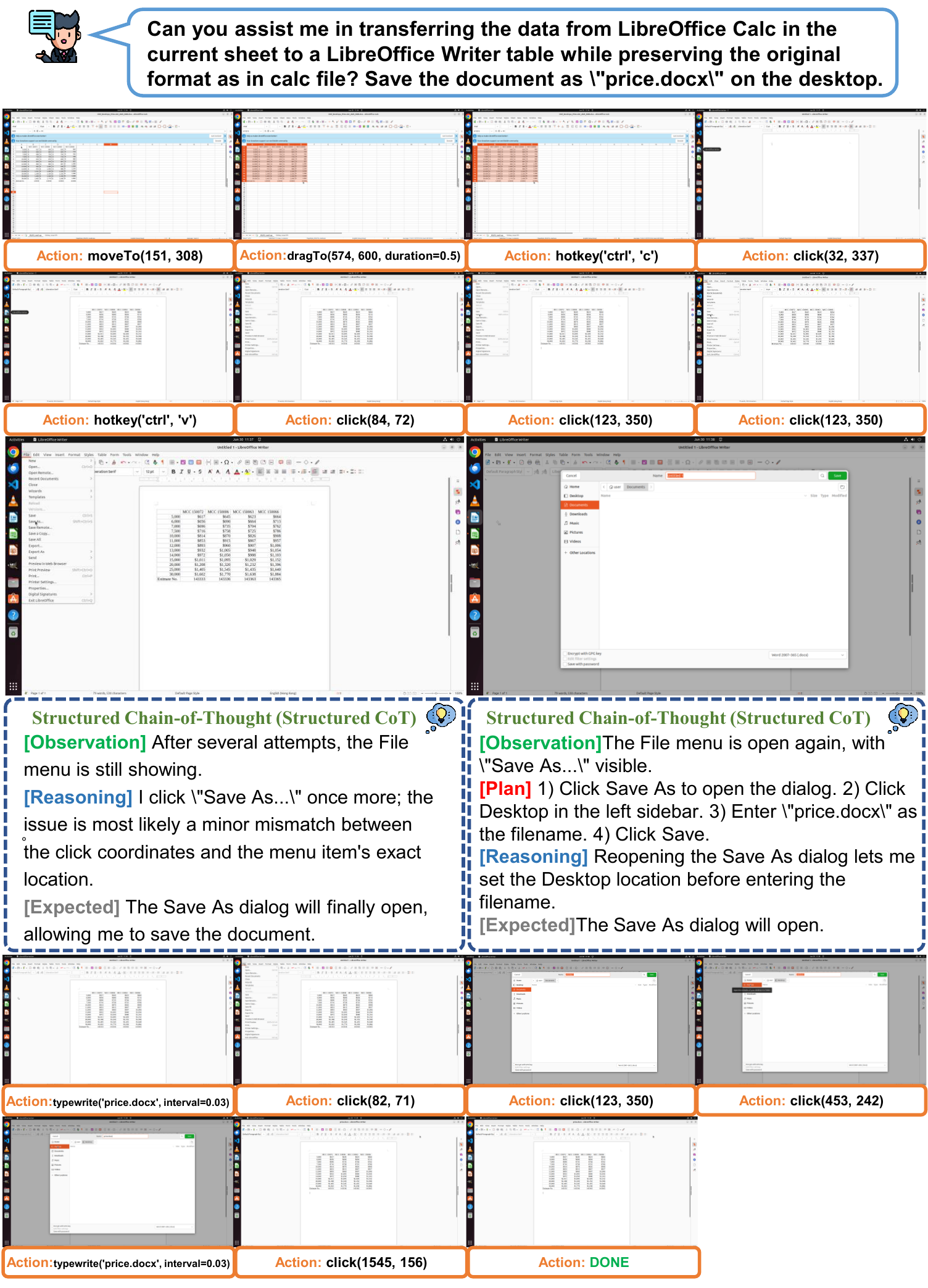
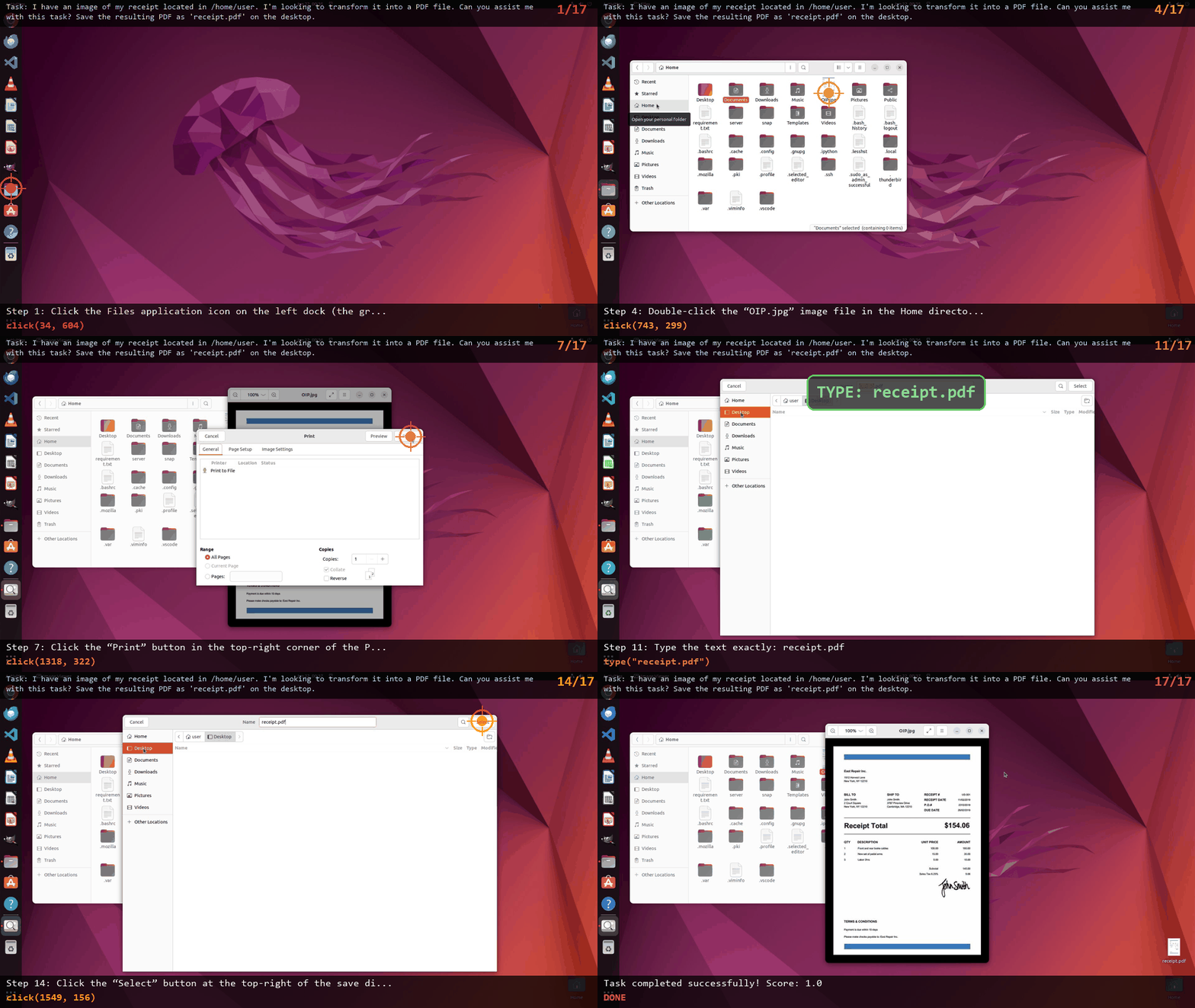
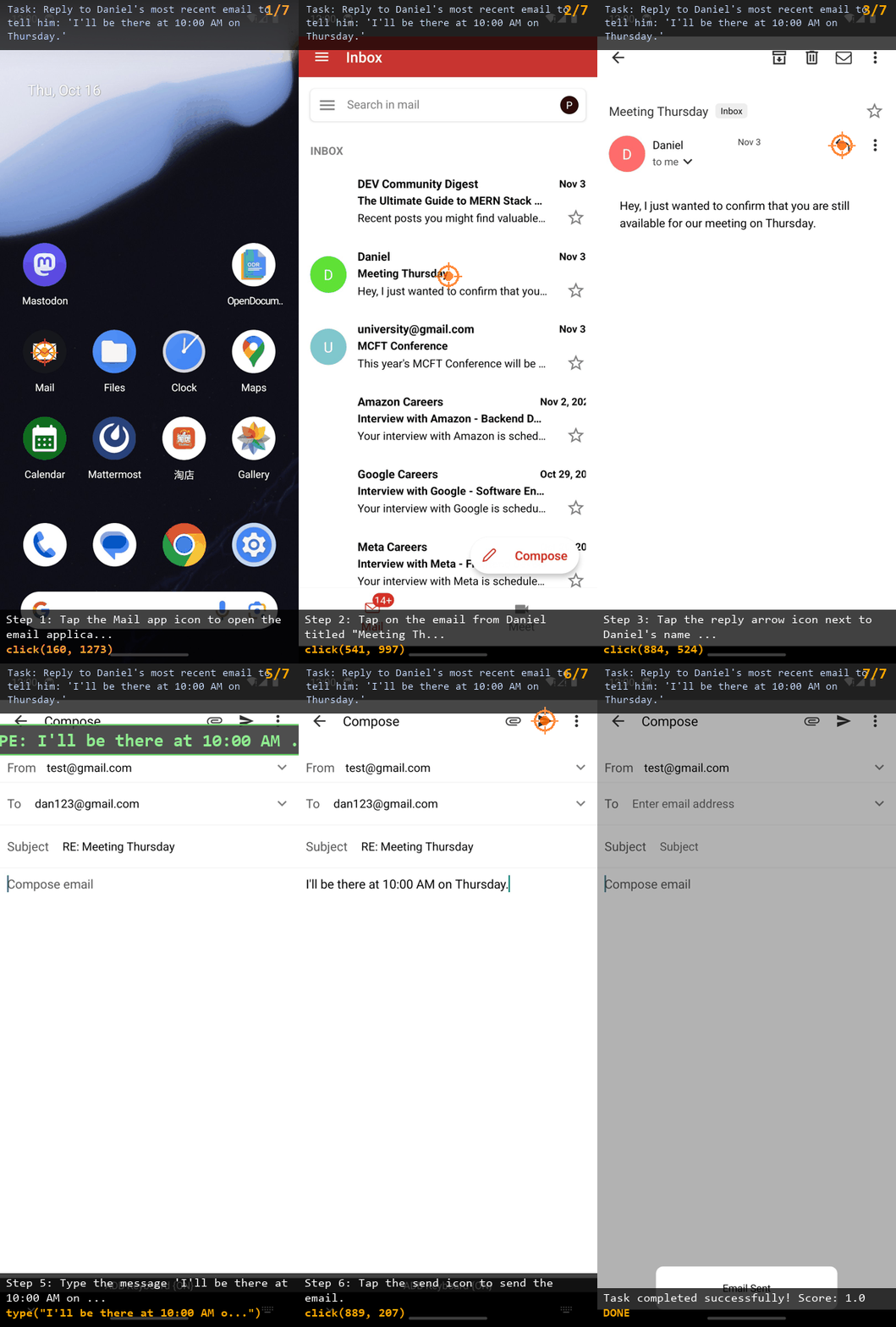
Watch our 8B student model complete real tasks step by step on both platforms.
Open file manager, locate receipt image, print to PDF, save to Desktop.
Open Mail app, find Daniel's email, compose and send reply.
@article{lian2026ui,
  title={UI-MOPD: Multi-Platform On-Policy Distillation for Continual GUI Agent Learning},
  author={Lian, Niu and Chen, Tongbo and Yu, Zhehao and Duan, Chengzhen and Liu, Fazhan and Liu, Hui and Fu, Pei and Luan, Jian and Qu, Heng and Xia, Shu-Tao and Wang, Jinpeng},
  journal={arXiv preprint arXiv:2607.04425},
  year={2026}
}